Friday, 21 March 2008

London for Beginners

Change of place for today, I'd have a couple of notes from London to offer where I spent Wednesday and Thursday. Going there and back on the bus (which is the cheapest short-notice way) should have lasted four hours each – actually the latter took a bit longer, but both were overall not quite worth a notice. However, I again felt that England is some centimetres (or inches or whatever the most useful unit would be) too short for me.
The hostel provided for nothing unexpected but a changed address combined with an unchanged map. However, we were only told this by Mr Reception (according to his sign next too the doorbell) who kept every hint of a hostel, e.g. stickers, maybe as a souvenir.

As I have only been to London once and in times immemorial, i.e. one and a half decades ago, and because of the limited time, I contended myself with the beginner's tour and mainly took pictures of important places. Camden Markets, Piccadilly Circus, Houses of Parliament, Buckingham Palace, St James's Park, Covent Garden, Tower Bridge and Harrod's are the keywords here.
Of course, I cannot suppress some comments about people that mainly concerns tourists here, because you rarely meet normal people in London. Interestingly, the French are the biggest group here, followed by Germans and Italians. Only at the Tower, they are second to the Germans – I have no idea what to conclude of that.
The omnipresence of tourists from Europe makes walking in crowds different from what I have gotten used to: they step to the right. I trained myself with effort to get rid of that instinct and suddenly there I constantly bump into people. I even believe that Londoners have let themselves adopt that behaviour and got pushed to the right side.

Finally just one comment as a comparison of London and Manchester. Upon returning the latter feels small, shabby and provincial. And this is not only the architecture, but even as much people's dressing habits. The girls there dress a bit classier and their taste allows for something else than miniskirts – but still the average height of the skirt seam is much higher than in Germany.

Enough talking, let the pictures speak.

Sunday, 9 March 2008

Memorials and Architecture

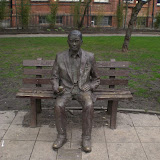
Today, by popular request, some pictures from Manchester. Featuring: the Alan Turing Memorial, the postbox that survived the IRA bomb, and some buildings in Manchester.

Memorials and Architecture

Monday, 3 March 2008

Unified

The English are said to be quite quirky. A good example provide their units of measurement which are totally absurd. I have researched this because for a continental European guy like me that has been taught the metric system it is strange to say the least. The English themselves are not really helpful in regard of knowing their own units.

Let's begin with basic nutrition: this is measured in pints. You order a beer of that size in the pub and I buy my milk in bottles of two pints. Milk comes in other manifolds and beer as half a pint, too. A pint is 568ml and as I recently bought a 570ml bottle of ketchup, this seems to be some kind of basic nutrition as well.

The next bigger size, e. g. the prize at a pub quiz, is the gallon. To make it easy, this is eight pints, i. e. 4.55ml. Those of you proficient in American units will have noticed the difference: an American gallon is only 3.8l. This could mean either that the Americans can bear less alcohol or are greedier when it comes to prizes.

On cooking utensils you can find even more units. There is the cup – not A, B, C etc. – which is half a pint. Then there are the ounces being 1/20 pint when liquid and 1/16 pound as a weight.

A pound itself is currently 1.30 € or 453g. Body weight is measured in yet another unit, the stone. I think this comes from the fairytale "Little Red Riding Hood" where the hunter replaces the girl and her grandmother in the wolf's stomach by their equivalent in stones. A stone is consequently 14 pounds (18.31 € or 6.53kg).

At last some legths: the mile is as long as in the USA, namely 1.6km or 1760 yards. The latter is the same as three feet which are 12 inches in turn. You can find all these units on the road: distances and speeds use miles, everything shorter is signposted in yards and heigths of bridges for instance are given in feet and inch, sometimes additionally in metres.

To sum it up: there are at least three units for everything, the factors between each two are always different. Let me repeat the numbers from the text above: 2, 3, 8, 12, 14, 16, 20, 1760. If you convert it to metric units, you get something odd and the Americans have their own units for some parts.

A positive thought at the end: if you have to live with this weirdness, you either develop a really good visual judgement or a good memory and fast mental arithmetic.

Saturday, 1 March 2008

Diplom-Informatiker

What a great feeling! Today I was addressed with my academic degree for the first time. However, it was only the University of Karlsruhe, and who should know but them? Actually, I think I had felt slightly disappointed if they hadn't used my degree in addressing me.

And by the way, they sent me the AlumniKaTH, their alumni magazine, which is not even glossy and of limited informational and entertainment value. But if anyone wants to go to the Hannover Messe (an industrial expo in Germany) as a guest of the Karlsruhe Institute of Technology (KIT), I'd have a free ticket to give away.

Wednesday, 27 February 2008

Survived!

Now I have to show a sign of life from me. I don't know if the news have made it to you, but here in England it's quite a topic (BBC): there was an earthquake yesterday night, even with a 5.3 on the Richter scale and I survived without mental or physical damages (which is certainly the good news).

It was quite an interesting experience to first see the water in the bottle next to my bed move. Then I didn't think it was special because it always does this when somebody lets a door fall shut anywhere in the house. But when my bed started shaking I slightly doubted it.

This morning I learned that it really was an earthquake. Seems like nothing too bad happened, apart from some knocked-down chimneys. After all, the city looked the same as it did yesterday.

That gives me the opportunity to present a before-and-after-picture of Alan Road (just one picture, because after the earthquake it still looks the same as before). And who knows me and my pictures from Australia can tell that it is only genuine with a sunset.

Alan Road before and after

Tuesday, 26 February 2008

Politeness 101: On the bus

English people are said to always be polite. I can confirm this with several observations. Let's begin with the first episode of a long series. “Politeness 101: On the bus”

It starts with the signs. They don't unpersonally say “Dienstfahrt” or commandingly “Don't Enter” like German Rail does – no, it is “Sorry – Not In Service”. Watch the order: first the apology, then a friendly “Not In Service”. And if the display at the side of the bus is too small for two lines, they alternate “Sorry” and “Not In Service”. This much of politeness needs to be, even if the bus seems to go to “000 Sorry” every couple of seconds.

Bus drivers are not only generally, but even almost without exception, friendly. My impression from Germany is that it's the other way round there. Here, they have different bus companies and they don't accept each other's tickets. As it happens, I entered a bus with the wrong ticket. The bus driver pointed this out to me (His sentence started with “Sorry”, of course) and I silently chuntering (I still can't deny my heritage) searched my wallet for coins and put the exact demanded fare (70p) on his till. But instead of taking the money with the same silent chunter (thinkig “Stupid foreigner/tourist/...”), he looked into his rear mirror and told me to take the bus that was just pulling up behind us, because my ticket was valid there. Thus, totally baffled, I took my saved money back and changed to the other bus.

But the politeness exists on the other side as well. Here, buses have only one door and thus you have to pass the driver on your way out. The English like to queue anyways, so why waste space for a second door? And guess what an English person does when they finally reache the door and can get off. They thank the bus driver! And they all do it, including the spoilt youth and drunk students. They even interrupt their conversation, even if it is on the phone, for that. So I took to turning my head to the right (left-side driving!) and calling – depending on my predecessors in the line, you want a little variation at least – a short “Thanks”, “Thank you”, “Ta” or “Cheers”. Often you get a “See you”, “Bye” or “Alright” back and find yourself happy and content on the street, all because of this short conversation with a bus driver you regard as a human being.

This enthusiasm is, of course, quickly brought down to a normal level quite often because you find yourself in the rain, but on average, going by bus is much more fun here.

Sunday, 10 February 2008

Piled Higher and Deeper

I know that this is no real excuse for not having written anything yet, but I was as busy as I was lazy. So I'm starting to tell you something about doing a PhD in the UK as far I have found out yet. This is really different from the German way, but compare it yourself.

The first thing about it is being a student. As such you have to pay quite high tuition fees (Home Fee for UK/EU currently £3.320 = 4.468 €, four times as much for everybody else) or you need a scholarship for that. I actually have another one for me, my food and my rent. There are no obligations in teaching for me, though it is appreciated if you sign up for "demonstrator duties" that are, however, separately paid.

The PhD program is quite tightly organised, at least the regulations are. I have exactly three years, i.e. until 31st December 2011. At the end of the first year I have to submit a transmission report – if this is nothing sensible, I'm getting an MPhil and may leave.

On the other hand, there is a lot of great help. I have a supervisor and a co-supervisor I talk to about my topic, an advisor I talk to about more general things and then there a student mentors. I had to attend a two-day workshop "Introduction to Reseatch (Speed PhD)" where we were told about all the formalities and what else there is to watch out for.

Being in a research postgraduate, I have no courses except a two-hour seminar on "Academic Writing". Partly helpful and entertaining: you get told stuff in anecdotes, e.g. how paper writing works. Who is first author, who is author at all, how to find a matching conference or journal, how to write a review. Thus it is not jumping in cold water when you actually have to do something like this.

The end is interesting as well. You write your thesis which is assessed by two people who are not your supervisors. One of them is at the faculty, the other is external, e.g. from another university. They are only reading the thesis and you have to defend it in an oral exam called "viva" in front of only the two of them.

It seems like there are no traditions except for a glass of champagne after the viva. No graduate hats or getting pulled around campus on a cart – this is where the Germans are better organised. If all of this is much better or worse, I'll still have to find out. Anyways, you have a lot of freedom and apart from the mentioned obligations I'm free to do what and how I like it.

Overall, it is not at all PhD-Comics-like, without annoyances and quite interesting. I like it, but I do have a place here to let you know about any frustration.

Next time I will certainly tell you some things about strange English people.